






In the entrance and exit system of modern buildings, the choice of door body not only affects the traffic efficiency, but also affects the overall space layout, safety and user experience. Among the common types of door bodies, "sensor door", "sliding door" and "automatic door" may be similar in appearance, but there are essential differences in driving mode, control logic, functional positioning and applicable scenarios.
For door control system accessories suppliers, installers or building contractors, understanding the differences between these three types of door types will help to better recommend suitable products to customers and achieve efficient configuration.
1. "Sliding door"-the most basic physical opening method
Sliding door is one of the most traditional and common door types. It is usually opened by manual pushing and pulling, and the door body slides horizontally along the track. This door has a simple structure and low cost, relying on a mechanical slide rail system rather than electronic control components.
Features:
Rely on manual operation, no sensors or control systems;
Stable structure, easy to install, simple maintenance;
No automation function;
Suitable for places that do not require frequent automatic passage, such as residential balconies, office partitions, and small shops.
2. "Automatic door" - the core representative of electric drive
"Automatic door" is a broad concept, referring to a door body that is automatically opened and closed by a motor-driven door leaf, and is equipped with a control system, sensor, guide rail and safety device inside. The triggering method of the automatic door can be diverse, including buttons, card swiping, passwords, face recognition, etc.
Features:
The core is motor drive and intelligent control;
Not limited to a certain triggering method, it can be manually controlled or system-linked;
Supports multiple configurations, such as linked door opening, remote control, and safety detection;
Widely used in automated places such as office buildings, hospitals, airports, hotels, and industrial plants.
Automatic door is a functional type, and the induction door is just one of the control methods.
3. "Induction door" - a specific implementation of automatic door
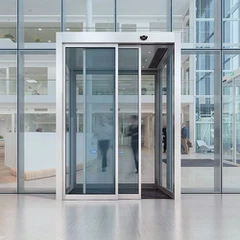
Induction door is actually a sub-category of automatic door, which refers to an automatic door system that automatically detects the approach of people or objects through sensors (such as infrared, microwave), thereby triggering the door to open. Users do not need to trigger manually, and "open when approaching" is fully realized.
Features:
Equipped with infrared or microwave sensors, accurate perception of movements;
Fast opening, sensitive response, and support for contactless passage;
More suitable for environments with dense crowds and frequent traffic;
Commonly seen in shopping malls, hospitals, supermarkets, banks, office buildings, etc.
4. Summary of key differences
Drive mode: Sliding doors rely on manpower, and induction doors and automatic doors are both electrically driven;
Control mode: Sliding doors have no control system, automatic doors support multiple methods, and induction doors specifically refer to induction triggering;
Technical structure: Induction doors include sensors, motors, guide rails and control modules, while sliding doors only need slide rails and door bodies;
Application scenarios: Sliding doors are suitable for low-frequency traffic places, and induction doors and automatic doors are oriented to modern intelligent buildings and high-frequency entrance systems.


