




In modern building access control systems, "automatic doors" and "electric doors" are two common door names. They are often used interchangeably or misunderstood, but from technical principles to usage scenarios, the two are actually fundamentally different. For manufacturers, parts suppliers, and system integrators in the supply chain, understanding the difference between the two can not only improve customer service quality, but also help to make more accurate product selection and technical configuration recommendations.
The following will comprehensively analyze the difference between automatic doors and electric doors from three core dimensions: application scenarios, drive methods, and control logic.
1. Differences in application scenarios: pedestrian passages vs. equipment entrances and exits
Automatic doors: with pedestrian traffic as the core
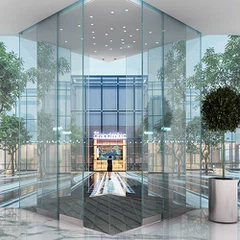
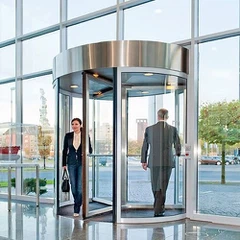
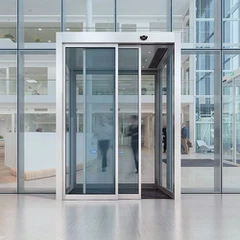
Automatic doors are mainly used in places where people pass through, emphasizing "intelligence, convenience, and safety". It is widely used in public areas or commercial buildings such as office buildings, hospitals, banks, shopping malls, airports, and hotels. It is a typical "high-frequency, light-load" application with high frequency of use and sensitive traffic requirements.
Features include:
Quick opening and closing, no contact required;
Used with access control, induction, and security systems;
More emphasis on appearance design and comfort of passage.
Electric doors: more suitable for equipment or vehicle entrances and exits
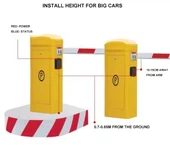
Electric doors are mostly used for physical partitions and access control scenarios, facing industrial plants, garage doors, warehouse logistics entrances, school gates and other areas, and are often used to control the entry and exit of people, vehicles or goods, with "low frequency, heavy load" characteristics.
Features include:
Sturdy structure, emphasizing wind pressure resistance, anti-theft, and durability;
Various opening methods, such as translation, horizontal opening, rolling curtains, folding, etc.;
Mostly equipped with basic control methods such as remote controls, buttons, and key switches.
2. Different drive methods: light load and high speed vs heavy load and strong
Automatic door drive system
Automatic doors generally use DC brushless motors or servo motors, and drive the door leaf to slide lightly through structures such as synchronous belts, guide rails and pulleys. The door opens quickly, runs smoothly, and has low noise, which is very suitable for indoor environments.
Features:
Soft power output, supports frequent opening and closing;
Low motor power, energy-saving and quiet;
Mostly sliding door bodies (such as translation, arc, etc.).
Electric door drive system
Electric doors usually use AC motors, gear reducers, and chain drive systems, emphasizing large output torque and adaptability to heavy door bodies or large-area opening and closing structures.
Features:
Powerful motor output, suitable for heavy doors or large-span structures;
Higher requirements for mechanical strength;
Opening and closing speed is slower than automatic doors, with large inertia during operation, often accompanied by warning lights and buzzers.
3. Differences in control logic: active identification vs. passive response
Automatic door control system
Automatic doors are equipped with a variety of sensing and recognition devices, such as infrared sensors, microwave sensors, card swiping, passwords, face recognition, etc., to form an intelligent response mechanism of "approach and open".
The core logic is:
The system actively identifies the target and executes the door opening command;
The controller has functions such as logic judgment, delay control, and abnormal self-checking;
It can be seamlessly linked with access control, security, fire protection and other systems.
Electric door control system
Electric doors are mostly controlled by manual triggering, such as buttons, remote controls, key switches, etc.; some high-end systems can be equipped with intelligent modules such as ground sensing coils, remote control APP, license plate recognition, etc., but the essence is still "passive response".
The core logic is:
The door opening action needs to be actively triggered by the user;
The control method is relatively basic, and the intelligent linkage is limited;
It usually does not support high-frequency interaction or segmented permission settings.