





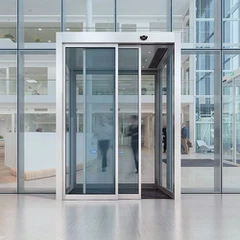




The following is an in-depth analysis of the working principle of the automatic door opener, combining a multi-dimensional analysis of sensor technology, mechanical transmission and intelligent control systems:
I. Core components and workflow
The automatic door system consists of four links: sensor detection → signal processing → drive execution → safety feedback, which constitutes a closed-loop control. Its operation process is as follows:
1. Target detection: Capture proximity signals through infrared sensors, microwave radars or pressure pads. New systems can integrate face recognition modules to implement authority verification
2. Signal transmission: The sensor transmits electrical signals to the control unit (PLC or microprocessor) to trigger preset logical judgments
3. Drive start: The controller activates the motor/hydraulic device and drives the door body to move through a gear set or belt drive
4. Motion control: The encoder monitors the door position in real time and adjusts the opening and closing speed and stroke (such as the hospital operating room door set to 0.3-0.6m/s slow start)
5. Safety monitoring: The infrared light curtain continuously scans the door area and immediately stops or reverses when encountering obstacles (response time ≤0.5 seconds)
II. Technical classification of sensor systems
1. Motion detection type
- Passive infrared (PIR): detects 9-10μm infrared rays emitted by the human body, low cost but susceptible to temperature interference
- Microwave radar: emits 24GHz electromagnetic waves, captures moving targets through the Doppler effect, has strong penetration and is suitable for harsh environments
- Laser TOF: uses the time of flight principle to measure distance, with an accuracy of ±5mm, used in high-end commercial places
2. Pressure sensing type
- Floor mat switch: mechanical pressure plate trigger, commonly used in bank anti-tailgating doors
- Piezoelectric film sensor: detects micro-strain signals, with a sensitivity 20 times higher than traditional switches
3. Intelligent recognition type
- RFID reader: 2.4GHz wireless radio frequency identification, effective distance 0-5 meters
- Binocular camera: calculates the distance between people through stereo vision algorithm, and can distinguish between people and objects
III. Mechanical principle of drive system
1. Electric drive (accounting for more than 80%)
- Gear reduction motor: adopts worm gear structure, reduction ratio 30:1~50:1, output torque 50-200N·m
- Linear stepper motor: directly drives the sliding door, positioning accuracy ±0.1mm, used in clean room scenes
- Brushless DC motor: efficiency > 90%, with inverter to achieve soft start/stop, extend the life of transmission parts
2. Hydraulic drive (heavy door application)
- The oil pump pressure can reach 20MPa, pushing the hydraulic cylinder to generate 10kN thrust, suitable for 5-ton hangar door
- Equipped with accumulator to achieve emergency manual opening, in line with fire protection regulations
3. Pneumatic drive (special environment)
- Use 0.6-1.0MPa compressed air, no electric spark risk, suitable for gas stations and chemical plants
IV. Safety protection mechanism
1. Anti-pinch design
- Contact type: rubber edge pressure sensor strip, trigger force ≤15N
- Non-contact: Infrared light curtain forms a dense protection net, with a minimum detection object diameter of 25mm
2. Emergency escape function
- Automatic release when power is off: After the electromagnetic clutch is disconnected, the door can be manually pushed open (thrust ≤ 130N)
- Fire linkage: forced to open and lock after receiving the fire alarm signal
3. Fault self-diagnosis
- Real-time monitoring of motor current and door position signal, triggering code alarm when abnormal (such as E01 represents overload)
V. Optimization of typical application scenarios
1. Medical clean door
- Airtight design meets ISO 14644-5 standard, equipped with HEPA filter and wind speed sensor
- Delayed closing function prevents airflow disturbance
2. Warehouse logistics door
- Radar + geomagnetic dual sensors, accurately identify forklift traffic needs
- Wind pressure resistant structure design, withstand 60m/s gusts
3. Barrier-free passage door
- Touch switch height is suitable for wheelchair users (0.9-1.2m from the ground)
- Door opening width ≥ 900mm, meeting ISO 7176-7 specifications
Maintenance strategy and troubleshooting
1. Preventive maintenance
- Lubricate the rails and hinges every 3 months, use silicone-based lubricants to prevent dust absorption
- Calibrate the sensor detection angle every 6 months, and adjust when the error is > 5°
2. Common fault handling
- Door jam: Check the guide rail for foreign objects or belt tension (recommended tension meter reading 25-30N)
- False trigger: Clean the sensor lens and adjust the microwave radar sensitivity to mid-range


